
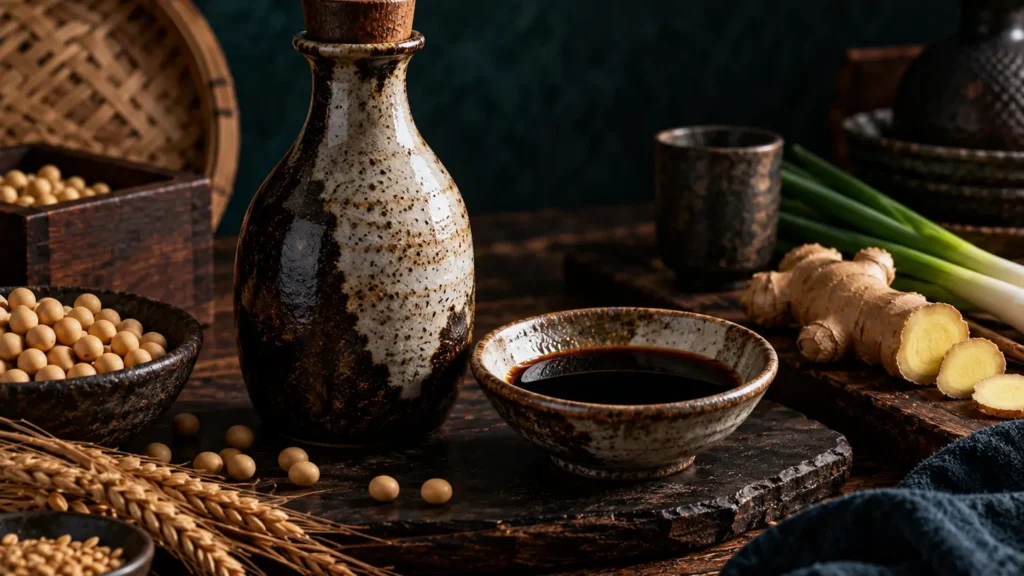
Before soy sauce became a supermarket staple, it was part of a much older solution to a basic problem: how do you stop food from spoiling? Its journey from ancient China to kitchens around the world is a story of fermentation, trade and adaptation.
IT STARTED WITH PRESERVATION
Soy sauce traces its roots back roughly 2,500 years to ancient China, when salt and fermentation helped preserve foods without refrigeration. Soybeans eventually became an important part of these fermented preparations.
But microbes were doing much of the work. Aspergillus oryzae, the mold associated with koji fermentation, breaks down proteins in soybeans and grains, helping create the deep savory flavor that would become soy sauce’s signature.
FROM CHINA TO JAPAN - AND EUROPE
Fermentation techniques later traveled to Japan, where producers developed their own methods. Soybeans were combined with wheat, salt and koji, forming the basis of Japanese shoyu. By the 1600s, Japanese brewers were producing soy sauce in large wooden barrels. Although Japan tightly restricted foreign contact, Dutch merchants were permitted to trade through controlled ports. By the 18th century, Dutch traders were carrying Japanese soy sauce toward Europe, helping turn an East Asian condiment into an international product.
SCIENCE EXPLAINS THE FLAVOR
Centuries later, Japanese chemist Kikunae Ikeda identified glutamate while studying the savory taste of kelp broth, helping establish what we now call umami. Fermentation had been producing this effect for generations. As koji breaks down proteins, glutamate is released, contributing to soy sauce’s rich savory depth.
FROM IMPORTED TO LOCALLY MADE
Soy sauce’s global journey eventually moved beyond export. After World War II, Kikkoman expanded in the United States and promoted soy sauce with foods familiar to American consumers. Then, in 1973, Kikkoman began brewing soy sauce in Wisconsin, using American soybeans and wheat rather than shipping every bottle across the Pacific. Soy sauce had become more than an imported Asian condiment. It was now being produced thousands of kilometers from where its story began.
Today, soy sauce appears in kitchens around the world. Yet every bottle still carries the legacy of an ancient idea: combining microbes, salt and time to transform simple ingredients into extraordinary flavor.