
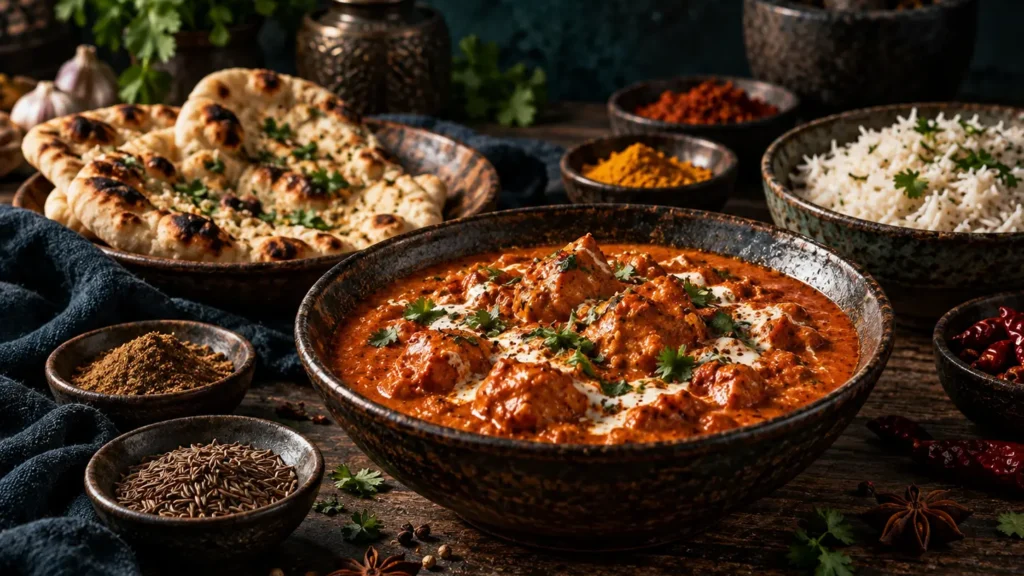
Chicken Tikka Masala has a wonderfully simple origin story: a customer complains that his chicken is too dry, a chef adds sauce, and a British classic is born.
The chef himself told that story. But the history behind the dish is much bigger than one Glasgow restaurant.
THE GLASGOW STORY
In the early 1970s, chef Ali Ahmed Aslam was running Glasgow’s Shish Mahal. According to Aslam, a customer ordered chicken tikka, complained that it was too dry and asked for sauce. The kitchen responded with a gravy made with tomato, yogurt, cream and spices. The customer loved it, and Aslam maintained that Chicken Tikka Masala was born.
It became the dish’s most famous origin story. But while Aslam certainly made the claim, no single origin story for Chicken Tikka Masala has ever been conclusively proven.
And similar culinary ideas already existed.
BEFORE THE MASALA
South Asian cooks had long prepared yogurt-marinated chicken using the intense heat of the tandoor. There was also an important precedent for combining tandoori chicken with rich tomato-based gravy.
After the Partition of India in 1947, Punjabi restaurateur Kundan Lal Gujral helped establish Moti Mahal in Delhi, where tandoori chicken served with a buttery tomato-and-cream sauce became associated with Butter Chicken.
Butter Chicken and Chicken Tikka Masala are not the same dish. But their similarities show that the combination of smoky tandoori chicken and creamy tomato gravy had strong South Asian roots.
WHEN CURRY MOVED TO BRITAIN
After the Second World War, growing South Asian communities transformed Britain’s food landscape. Restaurants and curry houses introduced British diners to South Asian dishes while also adapting recipes to local preferences.
Chicken tikka began appearing with creamy tomato gravies that varied from restaurant to restaurant. Some were sweeter, others spicier or richer. There was never one definitive recipe. Chicken Tikka Masala may therefore have developed not in one dramatic moment, but through years of exchange between South Asian cooks and British customers.
By the late twentieth century, it had become a British staple. In 2001, Foreign Secretary Robin Cook famously described it as a “true British national dish,” using it as an example of cultural adaptation.
Perhaps that is why finding one inventor is so difficult.
South Asian cooking supplied the foundations. Migration carried them to Britain. Restaurants adapted them to new customers. And somewhere in that exchange, Chicken Tikka Masala became something of its own.
Sometimes the migration IS the origin story.