
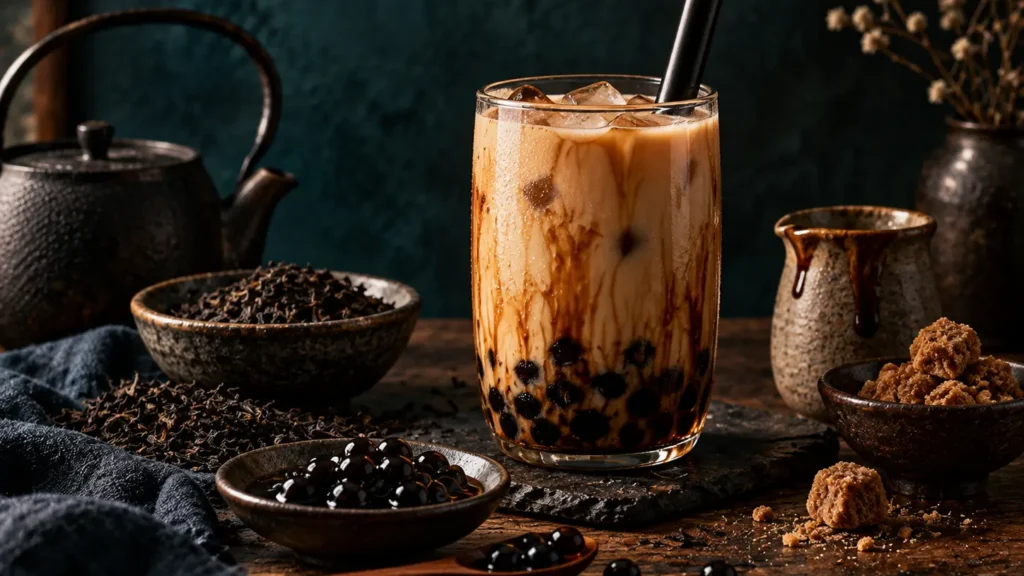
Bubble tea may have become an icon of modern Taiwanese food culture, but the chewy pearls at the bottom tell a much older story—one that begins thousands of miles away.
BEFORE BOBA THERE WAS CASSAVA
Pull a tapioca pearl through an oversized straw and it is easy to think of boba as entirely Taiwanese. But its essential ingredient isn't originally Taiwanese at all.
Tapioca starch comes from cassava, a root native to South America. Over centuries, cassava traveled through global trade and became an important crop across Africa and Southeast Asia before becoming part of Asian food traditions.
Its starch has a useful characteristic: when prepared and cooked, it develops a soft, springy chew. In Taiwan, that satisfying texture is often described as "QQ"—soft, elastic and pleasantly bouncy. So when Taiwanese tea culture collided with tapioca pearls in the 1980s, the combination made sense. Tea was no longer something people simply drank. Now they could chew it, too.
SO WHO INVENTED BUBBLE TEA?
That question became surprisingly complicated.
Two Taiwanese tea businesses became closely associated with competing claims to the drink’s invention: Chun Shui Tang in Taichung and Hanlin Tea Room in Tainan.
The disagreement lasted for years and eventually reached the courts. In 2019, a Taiwanese court ruling left neither business with exclusive ownership of bubble tea, meaning its precise inventor remains disputed.
Meanwhile, boba kept evolving.
Pearls became larger and sweeter. Tea shops introduced milk teas, fruit teas, jellies, foams and customizable sweetness levels. Even the word “boba,” originally referring to the tapioca pearls, came to describe the entire drink in many places.
FROM TAIWAN TO THE WORLD
As Taiwanese businesses and communities carried bubble tea overseas, it found enthusiastic new audiences. Its endless customization helped: customers could choose their tea, sweetness, ice and toppings. Its colorful layers and dark pearls also made it perfectly suited to the age of Instagram, TikTok and viral food culture.
What began as a Taiwanese specialty eventually grew into a multi-billion-dollar global industry. Yet inside every elaborate cup remains a surprisingly simple migration story.
A South American root crossed oceans. Its starch entered Asian food traditions. Taiwan paired its distinctive chew with tea. Then people carried that drink around the world. Sometimes food migration happens on a plate.
This time, it happened through a straw.