
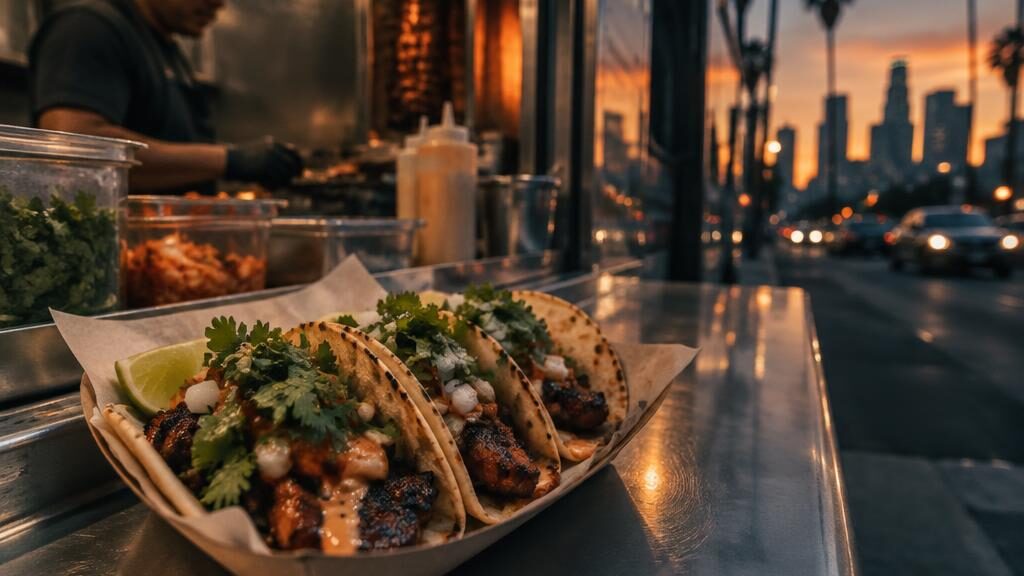
Korean galbi and Mexican tacos developed thousands of miles apart. In Los Angeles, their paths finally crossed—and helped turn a struggling food truck into a new model for fusion food.
TWO CUISINES MEET IN LOS ANGELES
A Korean barbecue taco hardly seems unusual today. But when Kogi Korean BBQ began serving them in Los Angeles in 2008, the combination was still something new to many customers.
The taco brought together two different food traditions. Korean "galbi" uses beef short ribs marinated with ingredients such as soy sauce, sesame oil and garlic, then grilled until smoky and caramelized. The Mexican taco offered the perfect street-food vehicle: a tortilla carrying meat, salsa and other toppings.
Los Angeles was where those traditions could naturally meet. Korean and Mexican communities had lived alongside one another across the city for decades, their neighborhoods, schools and food cultures overlapping.
Chef Roy Choi understood that environment firsthand.
Choi had trained at the Culinary Institute of America and worked in luxury hotels. But after losing his hotel job in 2008, a friend’s suggestion to start a taco truck sent his career in an entirely different direction.
PUTTING GALBI INSIDE A TORTILLA
Kogi’s signature taco wasn’t simply Korean meat wrapped in a tortilla.
Choi combined Korean-style short ribs with salsa, lime and crisp cabbage slaw. The acidity and freshness balanced the rich, sweet-savory beef, creating something influenced by both Korean and Mexican cooking. But getting people to try it was another challenge.
Kogi’s first nights were difficult. The team began visiting Los Angeles nightlife spots and giving tacos to workers. Curiosity spread, and crowds eventually started following.
WHEN STREET FOOD MET SOCIAL MEDIA
There was still one problem: the truck kept moving.
Kogi turned to Twitter, then a relatively young social-media platform, to announce where the truck would appear next. Customers could follow its location online and arrive before it moved again. The strategy helped create a mobile restaurant with a mobile audience—and became an important part of Kogi’s rapid rise.
By 2010, Food & Wine named Roy Choi one of its Best New Chefs, remarkable recognition for a chef whose most famous kitchen had wheels.
But Kogi represented something bigger than an award-winning taco.
Korean galbi met Mexican street-food tradition, not because someone randomly decided to combine two cuisines, but because both already belonged to Los Angeles. Kogi simply put that relationship on a tortilla.
And it tasted like the city that created it.